The Stack You Carry
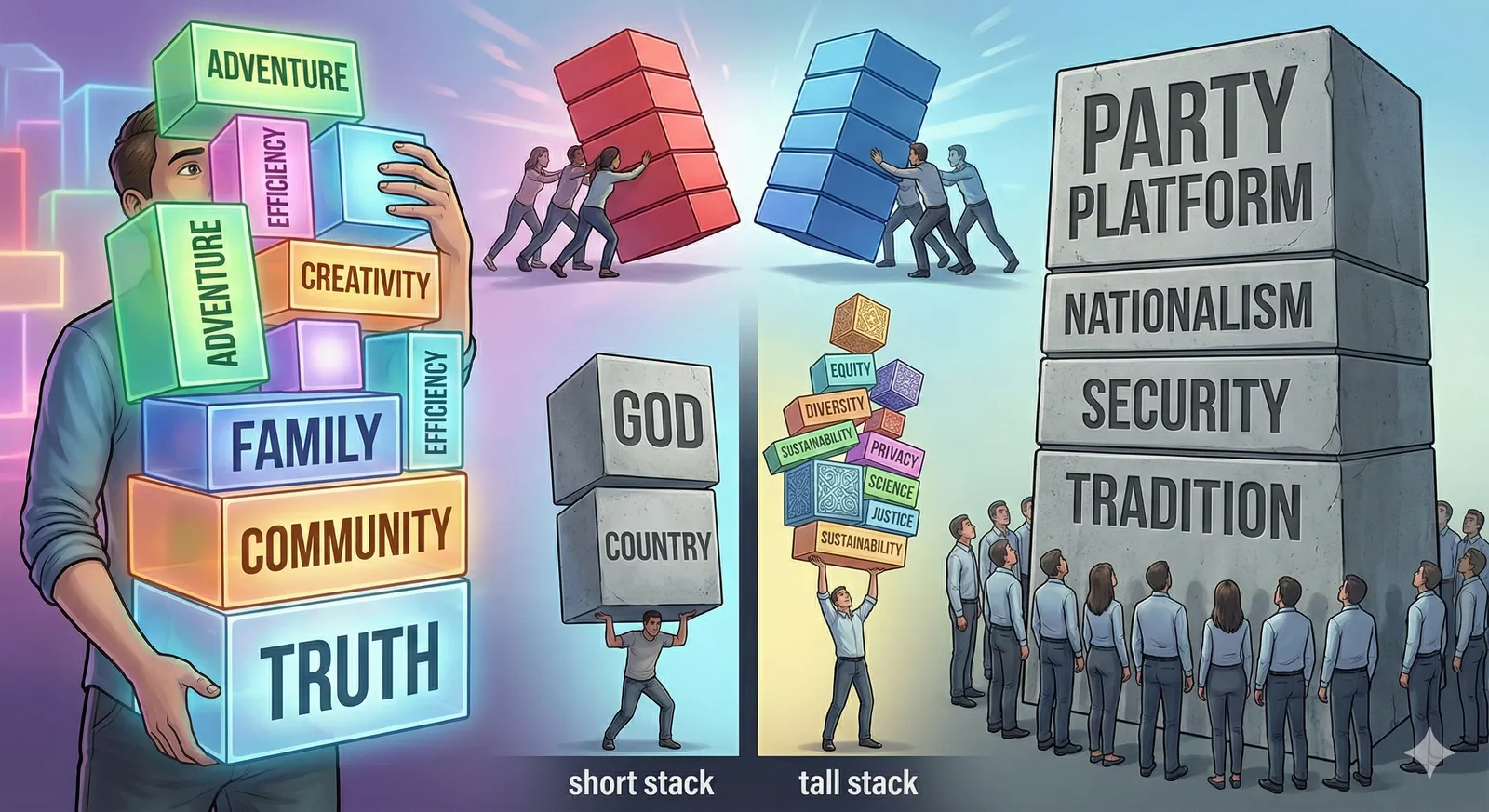
Someone I care about lobbed a political question at me recently - the kind that’s really an invitation to pick a side. I gave a nothing answer and let it die. Not because I don’t have opinions, but because I’ve had this conversation enough times to know the shape of it. We’d circle the same ground - not actually disagreeing about the facts, not even disagreeing about what matters. We both care about fairness, about safety, about institutions working the way they should. The conversation would go nowhere anyway, because we rank those things differently and neither of us can quite hear the other’s ranking as legitimate.
I’ve been thinking about this pattern for years, and the best metaphor I’ve found is a stack - a personal, weighted ranking of what matters most. Not a list of beliefs or positions. A priority ordering of values.
Everyone carries one, whether they’ve examined it or not. Freedom, safety, fairness, loyalty, autonomy, tradition, compassion, personal responsibility - most people care about most of these things. The differences show up in the ordering. When freedom and safety conflict, which one wins? When compassion and personal responsibility pull in opposite directions, which instinct is louder?
Two people can hold identical values and reach opposite conclusions about the same policy, the same event, the same vote - because their stacks are ordered differently. One person ranks economic freedom above collective safety. Another reverses that. Neither has to be lying, confused, or morally broken. They’re just carrying different stacks.
Stacks aren’t static. Mine has shifted more than once. What I ranked highest at twenty-five isn’t what I rank highest now - parenthood alone moved things I thought were fixed. Some values I treated as foundational turned out to be inherited assumptions I hadn’t examined. Others I dismissed as sentimental turned out to be load-bearing.
And they’re not logically clean. Someone can rank personal freedom at the top and still want the government to regulate the things that scare them. Someone can value fiscal responsibility and support programs that cost more than they save, because compassion outweighs the math in that particular case. The contradictions aren’t a failure of reasoning. They’re a feature of actually holding multiple values at once.
The stack is also only part of the input. Assumptions do real work underneath the ranking - beliefs about how the world operates that shape which conclusions the stack produces. If I assume government is generally competent at managing large-scale investment, my stack generates different policy conclusions than if I assume it’s generally wasteful, even if the stack itself is identical. Two people with the same values and the same ordering can still land in different places because they’re working from different models of cause and effect. The whole system is messier than the metaphor suggests - values tangled with assumptions tangled with experience tangled with things absorbed before anyone was old enough to examine them.
Some people resolve the difficulty by not maintaining their own stack at all. They adopt one wholesale from an authority - a political leader, a party platform, a media figure, a church. The appeal is real: a prefabricated stack comes with a community, clear answers, and no ambiguity about which value takes priority. It’s the mutual fund version of a value system - managed on someone else’s behalf.
And like a mutual fund, it scales. When thousands of people carry the same prefabricated stack, it becomes loud, coordinated, self-reinforcing. People still doing the individual work - still living with the ambiguity of values that genuinely conflict - are quieter by nature. Individual stacks are harder to organize around, harder to reduce to a slogan. The richness of genuine value reasoning gets drowned out by the sheer volume of the outsourced version.
This is part of what makes political polarization feel so intractable. The divide isn’t primarily about different facts or even different values - it’s about the refusal to accept that someone else’s ordering could be valid. When someone ranks economic freedom above collective safety, or vice versa, the instinct isn’t to hear a different priority. It’s to hear “I don’t care about safety” or “I don’t care about freedom.” The reduction of a stack to a single position - the flattening - is where conversations break down.
If there were one correct stack - a universal ordering everyone should arrive at - then disagreement would just be error, and the conversation would be about correction. That’s a cleaner world. It has clear sides and a right answer. The alternative - that someone I love might rank something I care deeply about quite low, and that this isn’t a moral failure on their part - requires a kind of tolerance that feels like giving ground.
The outsourced stacks make the flattening worse. A managed portfolio comes with built-in rhetoric for why the other ordering is not just different but wrong. It makes the holder fluent in dismissal without requiring them to engage with the actual structure of the disagreement - which is almost never about the values themselves, and almost always about the ordering.